01
Engineer with evidence
Measure before claiming. Test results, limitations and failures inform the next revision.
Tukzie is a University of Cape Town-led electric mobility programme developing a locally engineered vehicle platform for practical African mobility. Inspired by the African rhino, it brings together strength, resilience and purposeful design with real-world engineering.
What would practical electric mobility look like if the architecture, integration and engineering decisions were made here, around the conditions and capabilities found here?
That question became Tukzie — a physical platform through which students, researchers, academics and technical staff can design, build, test and improve electric mobility technologies in the real world.
The goal is not simply to assemble a vehicle. It is to build the capability to understand, adapt, service and ultimately create the technologies behind it.
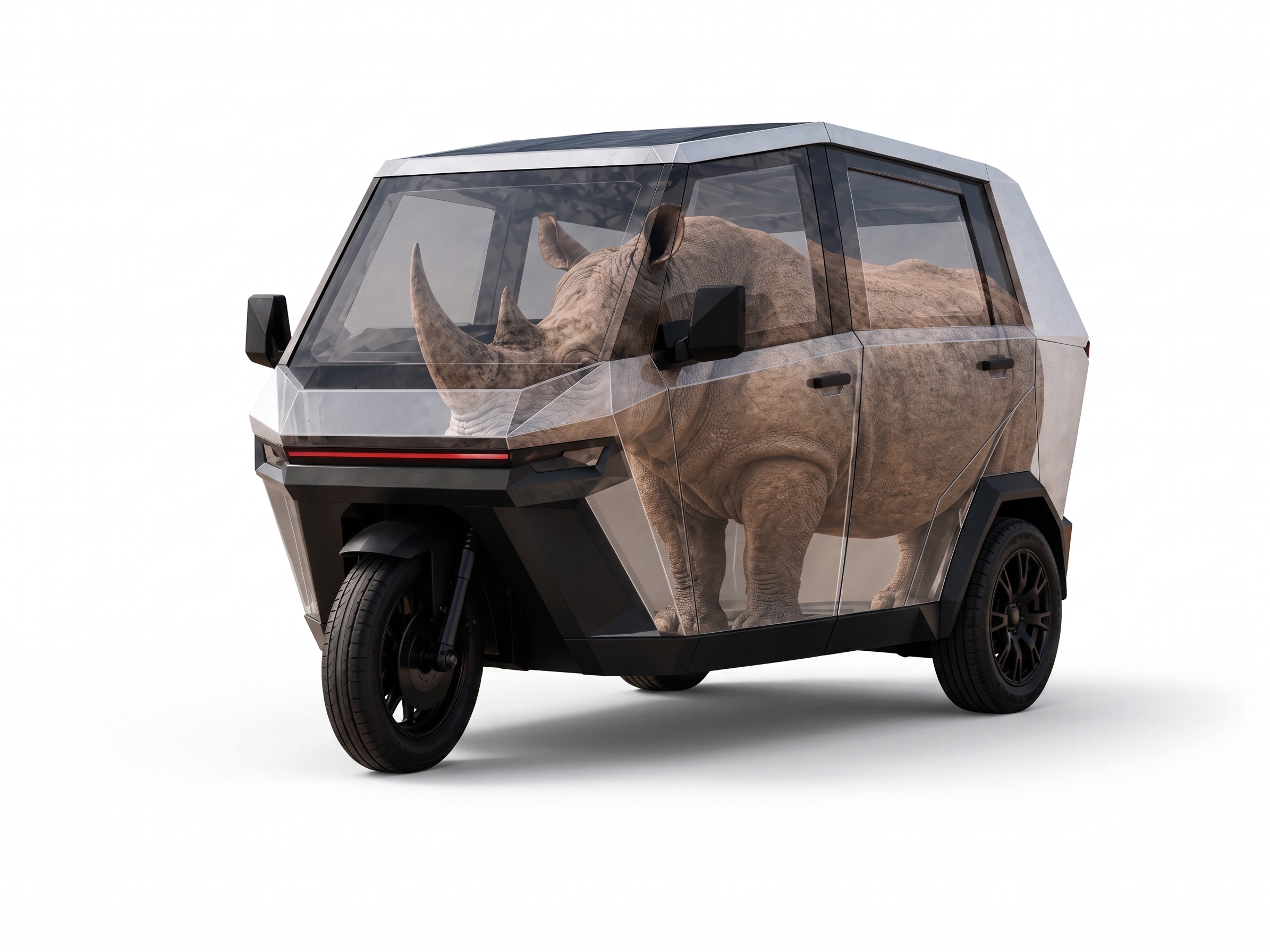
The African rhino influenced more than Tukzie's visual identity. Its strength, protective form, grounded stance and resilience became cues for the character the vehicle is intended to embody.
The rhino is not a mascot.
It is a design philosophy.
A robust architecture built around practical use.
An enclosed form that places occupants and critical systems within the vehicle architecture.
Designed with maintainability, repair and iteration in mind.
Form follows the job the vehicle must do — not decoration for its own sake.
Develop electric mobility that is practical to build, understand, maintain and improve locally — and prove the engineering through real prototypes and real testing.
Not engineering that ends with a render. Engineering that has to start, carry a load, climb a road, survive testing and come back to the workshop better understood.
Measure before claiming. Test results, limitations and failures inform the next revision.
Engineering decisions are shaped by practical operating conditions, infrastructure, cost and maintainability.
Serviceability, accessible diagnostics and replaceable systems are considered alongside performance.
Students and researchers work on a real integrated vehicle, where decisions must survive implementation and testing.
A future in which electric mobility used on the continent can also be engineered, integrated, maintained and progressively manufactured here.
Tukzie is a vehicle today, but the ambition extends beyond the vehicle: to create engineering capability, knowledge, research, skills and technologies that can support a broader African electric-mobility ecosystem.
Architecture, structure, dynamics and practical mobility.
Battery systems, charging, power electronics and energy integration.
Sensing, control, communications, telemetry and digital systems.
People, testing, manufacturing knowledge and local engineering experience.
Tukzie brings together academics, technical staff, undergraduate and postgraduate researchers across multiple engineering disciplines.
Industry and research collaboration is central to how the programme progresses from prototype to validated mobility technology.